

It is Thursday evening in Portland, Oregon, a little after 6:30, and rain ticks on the window of a small counseling office. Dana has a cup of tea going cold and a sticky note in her hand. Her last client said “I can’t” three times in fifty minutes: about the job search, about the phone call to her sister, about the unopened mail.
Dana thinks about the pep talk she could write and puts the pen down. She writes six words instead: “Notice the can’t. It can stay.” The question stays with her, and it is worth asking here. Why does “I believe I can” so often wake a voice that answers “no, you can’t”?
Why “I believe I can” sets off a voice that says you can’t
Belief asks you to claim something you have not proven yet. Your mind checks the claim against your memory, finds the times it went badly, and objects. That objection is not a character flaw. It is a comparison that runs in the background whenever you say something big about yourself.
What the doubt inside “believe” sounds like
Look closer at the word. Doubt rarely shouts. It sounds like a reasonable coworker: “Maybe next month.” “Someone else is better at this.” “You always start and stop.” Quiet doubt is easy to mistake for good judgment, which is why it works. A loud “you can’t” is easy to argue with. A murmur of “not today” slips by.
Naming it takes away some of its pull. In a 2007 brain-imaging study led by Matthew Lieberman at UCLA, people who put a name to the emotion on a face they were looking at showed lower activity in the amygdala, the brain’s alarm center. Calling the voice “doubt” does the same small job. It turns a verdict into a sound you can hear.
How to answer the quiet voice that says you can’t
- Name it. Say “that is doubt” out loud, or write the sentence on paper, word for word.
- Shrink the task. Cut it to a version that takes two minutes: open the document and write one sentence, or walk to the end of the street.
- Ask what you would tell a friend. Picture someone you love saying the same thing, then give yourself that answer.
Step one works best on paper. Write the exact sentence, “I can’t call my sister,” and read it back. On the page it looks smaller and more specific. Sometimes you find the real fear is “I don’t know what to say,” and that is a problem with an answer.
Step two keeps you out of the grind mindset. You are not building a streak or a new self by Monday. A two-minute start has to prove only one thing: the voice does not get the last word. If you keep going after the first sentence, fine. If you stop, the two minutes still count.
Step three borrows from research on self-distancing. In 2014, psychologist Ethan Kross and colleagues reported that people who spoke to themselves using their own name or “you” felt less anxious before a short speech than people who used “I.” Asking what you would tell a friend gets you the same distance.
One failure case is worth naming. If the doubt returns after all three steps, or it stays for weeks alongside poor sleep or a flat mood, a quiet reminder is the wrong tool. A licensed counselor is the right one.
Who a quiet reminder helps
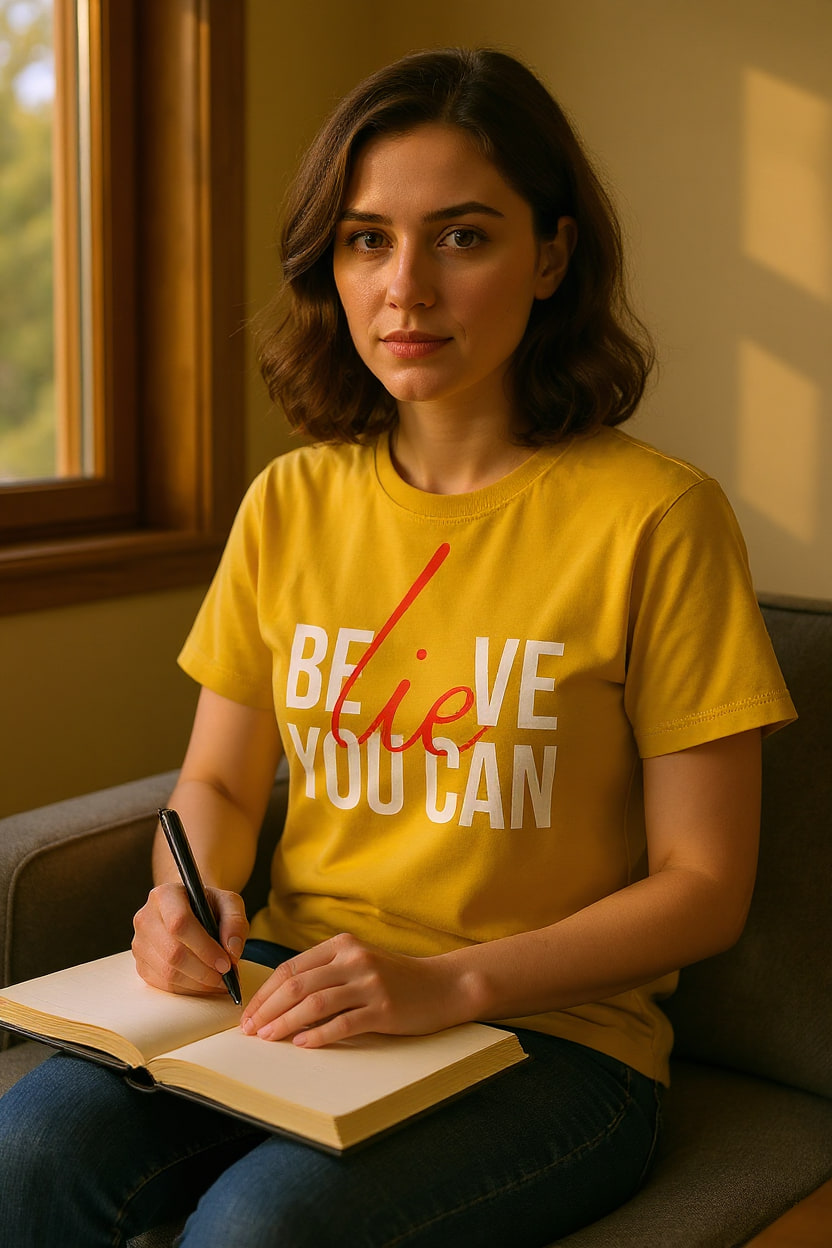
Words you see every day work like a sticky note on the bathroom mirror, except you carry them out the door. A motivational shirt does that job for the person wearing it, and the tone matters more than the size of the letters. Many motivational t shirts are written in the voice of a coach barking from a sideline. A softer line suits an adult who is tired, not broken.
Two kinds of reader come to mind. The first is anyone in a stressful week: a job search, a hard family call, a stretch of caring for a parent. The second is a person who holds others up: a teacher, a nurse, a counselor, the neighbor who buys flowers for whoever had a bad week. They hand out encouragement all day and rarely get a line of their own.

If you are curious how a short printed line fits different people, there is a calm answer to who a be yourself T-shirt is for, and a short account of how the Believe In Yourself line got made.
Doubt is not proof. It is a voice, and a voice can be answered one small step at a time. If you want a soft daily reminder to carry that thought, the Believe You Can tee is one place to start.


