

At 5:42 AM, a field recording from Yellowstone rolled across our studio monitors: long, even howls stepping in and out of each other, then quiet. The note we wrote on the pad under my coffee mug became the spine of this piece: a howl is coordination. We kept asking how a wolf shirt motivational enough for daily wear could say that without yelling.
The spark that set the stance
I sketched with a 2B pencil first, then traced with a 0.5 mm fineliner to fix the wolf’s posture: forward, ears up, mouth closed. No bared teeth. The gaze is set just above eye level so it meets you without staring you down. The first pass had the head angled 8 degrees left; we leveled it to 3 degrees so the body read steady, not stalking. The line under the jaw breaks for 2 mm to let the neck suggest motion without implying speed.
Next to the sketch, I wrote “Born To Lead” in block caps. Leadership here is not volume; it is cohesion. We framed the phrase as a field note, not a shout: statement, not slogan. If you’ve read our thoughts on picking calmer art in How to choose a calm, motivational wolf shirt, you’ll recognize that filter at work.
Building the silhouette without turning cartoonish
We chose a 1.2 pt outer line for silhouette and a 0.6 pt inner line for fur breaks and the eye. On lighter tees, heavy outlines go graphic fast; too light and the wolf fades. The muzzle and ear interiors use negative space, no fill blocks at all. On Sand, the nose bridge is a 3 mm gap that reads as light hitting bone. On Light Blue, we reduce that gap to 2 mm so it does not wash out in daylight.
Typography got three passes. Set in a humanist sans at 84 pt, “Born To Lead” lives as two lines with +30 tracking and a 92% vertical scale to keep it compact. The letters sit 62 mm wide under the chin, 14 mm between baseline and the wolf’s jaw. We tested a condensed cut; it felt clenched. The final is Regular weight, small caps, optical kerning on. The goal: a statement you absorb at a glance from 10–12 feet, then forget about up close because it behaves.
Print decisions that keep edges crisp
We print this on the Gildan 5000, midweight, 100% preshrunk cotton, because its tighter knit carries crisp edges without the ink bleed we measured on looser ringspun options. Our sample pulls showed a visibly cleaner ear tip on a 230 mesh screen versus 156; the 230 wins here. We run plastisol with a soft hand additive at a 90/10 mix to keep it flexible. Flash at ~220°F for 6–8 seconds, full cure at 320°F for 60 seconds; that sequence kept the fur micro-lines intact across all three colors.
Ink density trials were simple and repeatable: three decks, same art. On Light Blue, a straight black at 100% density looked stamped. We backed to 92% with a 15% halftone in the inner ear shadows; that restored depth without shine. On Sand, 96% coverage held the silhouette; shadows dropped to 10% halftone so the muzzle did not sink. On Blue Jean, we stayed at 100% but tightened the dot gain curve so the eye highlight, a 0.8 mm notch, does not fill under cure.
Placement is 2.5 inches (64 mm) below the collar at center, measured collar seam to the top of the eye. The Gildan’s seamless 7/8" rib collar keeps that top edge clean so the wolf does not crowd your neck. Double-needle hems keep the drape flat so the lower line of type does not arc when you sit. It is the small stuff that reads as calm.
Late morning, we photographed the Sand tee in a home workspace to check how the lines behave in soft window light, the moment when a shirt should disappear into your day and still hold its message.
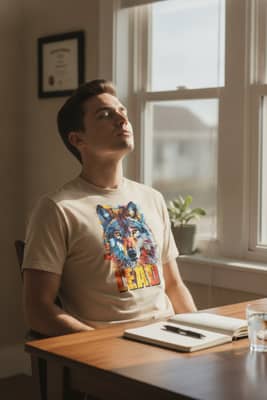
Wear test loop: three days that matter
Day one: a dawn run on the boardwalk in Light Blue. We logged heart rate on the watch and something else: how readable the type stayed as I watched my reflection pass storefront glass. At 8–10 feet, “Born To Lead” resolved in a single glance even as the fabric moved. Sweat halo at the collarbone did not ghost the ink; the 92% density choice held.
Day two: therapy-day commute in Blue Jean. Backpack strap off the print, then on again, three blocks to the community center, early evening. Streetlights clicked on at 7:21 PM. Under that sodium tint, the wolf’s eye still popped. Friends talked two steps behind; no one’s attention snagged on the shirt, which is the point. If you are curious how we think about apparel that supports, not spotlights, we wrote about that in the Fox hoodie for people who move anyway.
We shot exit frames there to check legibility against mixed light and motion, real sidewalks, not studio cycloramas.

Day three: first-day-on-the-job check in Sand. Elevator mirrors are unforgiving, so we tested centered print drift. We marked placement with a 64 mm spacer and verified after wear; drift was under 2 mm across sizes S–XL. In quiet office light, the outer line reads as a shape first, then the gaze. That is the “Alpha Wolf Tee” you can wear into a 9 AM without it entering the room before you do.
Washes: 10 cycles, cold, inside-out, mild detergent, tumble low. Post-wash delta on the eye highlight was under 0.2 mm, still visible at arm’s length. We nudged the type tracking +5 and raised it 3 mm after cycle five so the phrase clears the natural fold line on more torsos. Small changes, big calm.
This is Printed Apparel built to remind, not to bark. The art is restraint; the print is precise; the fabric is steady. Born To Lead is not an order; it is a job quietly done so nobody gets left behind.
How to make a coordinated, calm wolf tee
- Begin with a field cue. Listen to real howls and decide the posture that says “coordination,” not threat.
- Draw the silhouette with two line weights; protect negative space at the muzzle and eye.
- Set “Born To Lead” as a statement: Regular weight, generous tracking, centered under the chin.
- Choose a midweight cotton (Gildan 5000) and a high-mesh screen to keep edges crisp.
- Test ink density per colorway; adjust halftones so shadows read without shine.
- Place the art ~2.5 inches below the collar; verify alignment across sizes.
- Wear-test in motion, mixed light, and quiet rooms; tweak tracking and contrast for 8–12 ft readability.
- Run 10 wash cycles and recheck micro-details like the eye highlight before locking files.
If this story resonated, take a closer look at the studio notes and final print passes for Born To Lead.


