

Dana stood in her Denver apartment on October 24 with a costume receipt folded into quarters in her hand. She was 31, her brother’s party was that weekend, and the costume had looked funny in the product photo. He wore it once, posed for two pictures, and returned it the next morning.
The year before, she had given him a plain gray hoodie. It was not a Halloween joke or a party prop. By November 30, she had seen it in his grocery-store photos, on a Sunday walk, and under his coat when the Denver temperature dropped. The useful lesson is simple: judge a Halloween gift by whether the person would choose it on November 2.
Hoodie vs. tee: which Halloween gift gets worn after October?
| Option | Best for | Weather and layering | Gift budget to set | Common failure case |
|---|---|---|---|---|
| Halloween costume | One party or a specific group plan | Often needs separate layers outdoors | Set a one-night budget before shopping | The recipient has no reason to wear it after October 31 |
| Graphic tee | Mild weather, indoor plans, and packing light | Fits beneath an outer layer | Set a tee budget under $30 if that fits your plan | The graphic only makes sense on Halloween |
| Hoodie | Cool evenings, walks, or casual weekends | Works alone or under a coat | Choose a hoodie budget of $35 to $60 before comparing options | Buying a unisex size too small for the relaxed fit the recipient expects |
Use the three-question test before choosing
First, ask: will they wear it in a month? A pumpkin-face costume may pass for October 31 and fail for a Tuesday in November. Look for a design with a seasonal touch that still feels like something they would wear after the holiday. For ideas that keep a Halloween edge without becoming a costume, see this guide to wearable wildlife tees and hoodies for Halloween plans.
Second, ask whether it fits a normal week. Picture the recipient’s actual routine: commuting in cool air, working from home, picking up coffee, or walking the dog after dinner. A tee makes sense for someone who layers every day. A hoodie makes sense for someone who reaches for one extra layer from October through November. Do not assign either choice a personality; use the weather and habits you have seen.
Third, ask whether the message suits them. An inspirational hoodie works when its words sound like the recipient, not like a lesson you are trying to give them. Read the phrase aloud and imagine them wearing it around people who know them. If it feels too private, too loud, or unlike their usual humor, remove it from the shortlist.
When a tee is the better gift
Choose a tee when the recipient lives in a warmer place, prefers layers, or has a jacket they wear constantly. A tee also reduces the sizing risk when you can compare a favorite shirt laid flat: measure from underarm seam to underarm seam, then double that number for the garment’s chest circumference.
A farmers-market morning is a useful test scene. A tee should look right with jeans, a light jacket, and a paper bag of small pumpkins, rather than requiring a party invitation to make sense.

For fabric, read the garment specification instead of relying on a product photo. Bella+Canvas lists its 3001 unisex jersey tee at 4.2 oz./yd² and 100% Airlume combed and ring-spun cotton for solid colors. That number gives you a comparison point when one listing simply says “soft cotton.” Heather colors can use a different fiber blend, so check the color-specific line before ordering.
When a hoodie is the better gift
Choose a hoodie when the recipient spends time outside after dark, runs cold indoors, or lives where Halloween means a coat by the end of the evening. It is the practical choice for passing out candy, walking home from dinner, or taking a dusk loop through a neighborhood with porch lights on.
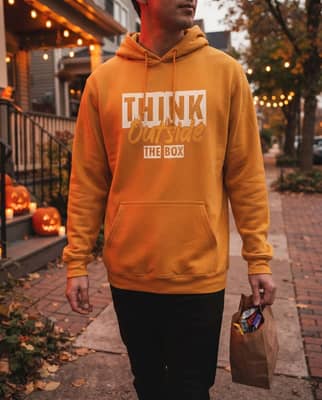
Check the weight and fiber content before you compare colors. Gildan’s Heavy Blend adult hooded sweatshirt specification lists an 8 oz./yd², 50% cotton and 50% polyester fleece. Other hoodies use different weights and blends, so treat “fleece” as a construction word, not a complete fabric description. The listing should state the fiber percentages, garment weight, and care instructions.
The sizing mistake happens when a shopper uses a fitted tee size as the answer for a unisex hoodie. “Unisex” describes a shared size range; it does not promise the same fit as a women’s fitted shirt or a slim men’s sweatshirt. Find the recipient’s favorite hoodie, lay it flat, measure chest width and body length, and compare those two measurements to the brand’s size chart. If the chart is in inches, use inches throughout rather than converting midway.
Make a two-item shortlist
Keep one tee and one hoodie in the final round. For each, note the chest measurement, fabric blend, garment weight, and the November situation where it would be worn. This turns a vague “Which is better?” into a choice with a clear reason. For a closer look at matching a phrase to the person receiving it, read how to choose an inspirational hoodie as a Halloween gift.
If you want a gift built around that November test, browse our typography hoodies.


