

“Never give up” does not have to mean “push harder.” The common reading gets one thing right: persistence can matter when a goal still fits your life, but it fails when it turns every pause into a personal defeat.
What does “never give up” mean in a gentler reading?
A gentler reading separates quitting yourself from changing a plan. “Never give up” can mean keep your dignity, values, and willingness to begin again, while still resting, asking for help, or choosing a different direction. Staying strong means staying steady, not proving how much strain you can carry.
That distinction matters because slogans are often read at their loudest. A message that could mean “take one more small step” becomes “work through exhaustion,” and a difficult season becomes another test of character. The mistake is not wanting resilience; it is treating resilience as nonstop output.
Why persistence quotes can feel like grind language
Many familiar phrases were built for a clear moment: finish the last mile, return after a setback, keep practicing a skill. They get less useful when applied to every part of a life. A job can be changed. A deadline can be renegotiated. A routine can be reduced from 60 minutes to 10. None of those choices requires someone to abandon their own worth.
The World Health Organization describes burnout in ICD-11 as an occupational phenomenon resulting from chronic workplace stress that has not been successfully managed. That definition does not make a T-shirt slogan medical advice, but it does name the failure case in grind language: a person can hear “keep going” as a reason to ignore mounting strain at work.
A better test is simple. If a strong message leaves no room for sleep, a changed plan, a boundary, or another person’s help, it is demanding endurance rather than offering encouragement. If it leaves room for all four, it can be a quiet cue to continue in a way that is still livable.
Stay steady instead of performing strength
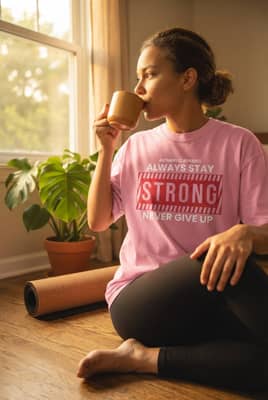
Try translating “Always Stay Strong Never Give Up” into three plainer permissions: rest without calling it failure; change course without calling it quitting; and ask for help without calling it weakness. The words do not lose their backbone. They just stop making a hard week into a contest.
This is also why a calm-first reading of “Protect Your Peace” lands differently from a command to conquer the day. Both can be reminders, but the first asks what deserves protection before it asks for more effort.
Who a quiet reminder can suit
A stay strong shirt can fit someone navigating a hard season, a person who wants a low-key daily cue, or a counselor who spends a working day hearing difficult stories. It can also suit a friend who prefers a message with room for nuance over a line that sounds like a locker-room speech.
The setting matters more than the slogan’s volume. A tea break, a walk, a garden task, or 15 quiet minutes before a meeting can make a phrase feel like a personal reset rather than a demand. For another gentle message with an animal-led approach, see how deer art, text-only designs, and loud graphics change a kindness message.
What to check in a tee with a motivational message
Words set the tone, but fabric affects whether a shirt becomes part of an ordinary week. For a worn-in, substantial feel, check the garment details rather than relying on a product photo: 100% ring-spun cotton identifies the fiber and yarn; garment dyeing colors the finished garment; heavyweight fabric gives the shirt more structure; and a relaxed drape gives the body and sleeves more ease.
Comfort Colors describes its garment-dyed products with a lived-in color effect, and the listed Always Stay Strong Never Give Up tee uses 100% ring-spun cotton with a heavyweight, relaxed fit. Those are concrete details to compare with your preferred shirts at home: look at the fiber content on the neck label, the fit through the shoulders, and whether you like a tee that hangs away from the body rather than clings to it.

A motivational quote shirt works best when the sentence still feels fair on a difficult day. Read it out loud and ask one question: does it make room for being human? If the answer is yes, it may be a reminder worth keeping close. The same principle can help with bolder language too, as this look at why “Born To Lead” does not need to mean being the loudest shows.
If a softer version of persistence is the reminder you want to wear, the Always Stay Strong Never Give Up Comfort Colors tee is a thoughtful next step.


